Friday, March 10, 2006

Robert Smith Mabry, Jr.: War, Marriage and Children in Fayette County (1851-1884)

Robert Smith Mabry, Jr. grew up in Marion County, Illinois. After the death of his father in the mid-1840s, Robert moved south to live with his brother Joel in Pulaski County. He didn't live there long. By 1851 he had joined his brother Dudley in Fayette County.

Marriage to Susannah Smith
On December 14, 1851, Robert Smith Mabry, Jr. married Susannah J. Smith, daughter of William and Anna Smith, in Sefton Township in Fayette County, Illinois. That is where the young couple settled down on a farm. They had no children of their own, but when the 1860 census was taken, Robert's niece Sarah Mabry (daughter of Joel) and a William Nesbit*, both age 9, were living in their household.
1860 Census, p. 136, showing R.S. Mabry and household. (Note that I can't really see the information on the linked image, but if you want to take a look, the household is the last entry on the page.)
* There was a Nesbit family living near the Mabrys in Sefton Township. William, who was living with the Mabry family in 1860 and 1870, may have been a relative.

The Civil War
During the Civil War, Company F of the 7th Illinois Cavalry was primarily made up of young men from Fayette County. After suffering great losses over the winter of 1865 (mostly due to disease), the company returned to Fayette County to recruit replacements.
January 13, 1865, found the command at Gravelly Springs, numbering 199 officers and men for duty, and they subsisted for about ten days on parched corn after arriving there. On the morning of December 13, 450 men were reported for duty, showing a loss of 251 in the short space of one month. After remaining at Gravelly Springs about three weeks the Fifth Division was dismounted and sent to Eastport to receive recruits, who poured in from every quarter, until the Regiment numbered over 1,600 men.(History of the 7th Illinois Cavalry Regiment)
Among those who enlisted was the almost-40-year-old Robert S. Mabry. His wife, Sarah, had died on November 4, 1864 (buried in Guy Cemetery in St. Elmo). He had no children whose support would be neglected while he served his country. The muster roll lists him as 34 years old (probably a typo for 39). He is described as 5 foot 11 inches tall, with dark hair, gray eyes and a dark complexion. Already serving in Company F were his younger brother George, nephews Joel N. and William W. Mabry (sons of brother Dudley), and William D. Mabry (son of brother Richard).

Robert fortunately did not have to serve long; he enlisted on March 8, 1865, just one month before Lee's surrender at Appomattox. He and the other recruits probably joined the 7th Cavalry at Eastport, Mississippi, where it stayed until May.
After the surrender of the rebel armies [in April] it was sent down to Okalona, Miss., where it remained until the first of July. It then moved to Decatur, Ala., and was mounted. It remained near Decatur until October 20, when it marched to Nashville and was mustered out of service and received its final pay and discharge November 17, 1865, at Camp Butler. (History of the 7th Illinois Cavalry Regiment)
Additional Information
Previous post: Civil War Soldiers of Fayette County
Illinois muster and descriptive rolls
Company F, 7th Cavalry Roster
7th Cavalry Regimental History

Despite the relatively short duration of his service, it took a toll on his health. According to the application for a military pension by his widow:
My husband was a stout able bodied man before entering the U.S. service [...] Came back with Lung disease of which he died." (from the pension application of widow Esther (Bayles) Mabry, who married Robert in 1868. Similar statements were made by others who knew him)
According to affidavits filed by Morris German and John Goodbrake who served in Company F with Robert,
[he incurred a cold from lying on wet floor at Camp Butler] from which a hacking cough was contracted and continued until his death [A]t times could not speak above a whisper his cough became deeper every year [...]
After the Civil War
After his discharge from the army, Robert returned to his farm in Sefton Township.

1875 Map of Fayette County, Illinois. The Mabrys probably lived in southern Sefton Township, near Brownstown**. Present map of the area.
1880 Census, p.112C, Sefton Township, Fayette County, Illinois (transcription of R. S. Mabry and family).

On January 9, 1868, Robert married Esther Jane Bayles, almost 25 years his junior. Esther had moved to Fayette County from Muskingum County, Ohio with her parents, Thomas and Louisa Bayles, in the 1850s. Robert and Esther were married by Justice of the Peace George Fletcher near the town of St. Elmo, probably at Esther's home.

Robert and Esther had six children: Harry Clarence, Joel McKane "Joe", Jennie Littlejohn, Thomas Greenville, Robert Smith (who died at age 3), and Isaac Paris "Pete" Mabry.

The Mabrys continued to live on the farm in Sefton Township until Robert's death in 1884. At that time of his death, his oldest child, Harry, was only 16. The youngest sons, Pete and Thomas, each inherited 160 acres, which were held in trust until they came of age**.

Esther, Robert's widow, married for a second time, to Elkanah Smith, in 1889. She died 3 years later. Esther is buried in Guy Cemetery, in St. Elmo.

** According to the pension application filed by Esther, Robert S. Mabry died at Brownstown, Illinois, where Esther lived in 1888. The information about the inheritance of Thomas and Isaac is also from that application. It is not clear if the older children also inherited land from their father - the focus was on Thomas and Isaac because they were the only minor children at the time the affidavit was filed. Joe was the only Mabry son who continued farming.

Obituary of Robert S. Mabry:
This is from a scrapbook of R. Neil Mabry prepared by his daughter Jackie (Mabry) Kolm. Unfortunately, it didn't indicate which newspaper printed the obit. It is not known who supplied the information about his birthplace, which should be Logan County, KY.
Robert S. Mabry was born Dec. 27th, in Feuknen[sic] county, Ky. Removed together with his parents to Illinois in the year 1831. Died at his residence in Sefton township, Fayette county, Ill, March 31st, 1884. Was married to Esther J. Bayles Jan. 9th, 1868, who now mourns the loss of a husband. He also leaves four sons and one daughter. He was a consistent member of the M. E. Church for a number of years, where he will be sadly missed, as he was always in his place bearing his part. he suffered much during his last sickness, but bore it with Christian fortitude, and expressed a willingness to die. On Sunday, morning previous to his death, he called his friends present to his bedside, and had them sing his favorite hymn-"O happy day that fixed my choice," &c. His remains were conducted to the cemetery at St. Elmo, on Wednesday following by a large company of friends, where he was laid to rest. "Blessed are the dead who die in the Lord from henceforth. Yea, saith the spirit, that they may rest from their labors, [illegible] [illegible] works do follow them".
S.F.I.

Labels: , , ,


Read the rest of this post.

Saturday, March 04, 2006

When and where did Barbara (Weiser) Holben die?

According to family legend, the widowed Barbara (Weiser) Holben left Edinburg in Christian County, Illinois with her two youngest daughters, Gertie and Ora, in September of 1893. She supposedly joined the tens of thousands of other potential settlers making a "run for the land" in Oklahoma. The only land run in Oklahoma in 1893 was the so-called Cherokee Outlet, on September 16th of that year. Unfortunately, Barbara caught pneumonia before they had lived on their claim for 30 days, and they lost the land. According to the family story, "Gertie and Ora rode the wagon with her casket". You can read all the details in mom's excellent post.

It turns out that actual story may be more complicated, however.

The information we have about Barbara's trip to Oklahoma and her subsequent death are stories passed down from her daughter, Gertie, who was 12 at the time of her mother's death. I believe that most of this information comes from Vernalee (Rowe) Loy, Gertie's granddaughter. It isn't particularly surprising that some of the details might have been remembered incorrectly.

What are the main elements of the story?
- Barbara (Weiser) Holben traveled to Oklahoma in 1893 with daughters Gertie and Ora
- she made a "rush for the land" on September 16, 1893
- she died September 23, 1893, less than 30 days after staking a claim. One version of the story says she died in the town of Edmond, which is not in the area where land was being claimed, but is where her daughter Carrie (Holben) Alexander lived with her family.
- her casket was returned to Edinburg, with Ora and Gertie traveling along

Can this story be verified at all?

- Barbara Holben is not in the list of names of people who claimed land in the Cherokee Strip in 1893. This list is not thought to be complete, however.

- Most Oklahoma counties did not begin to keep death records until statehood in 1908, so it's unlikely we would be able to find a death certificate.

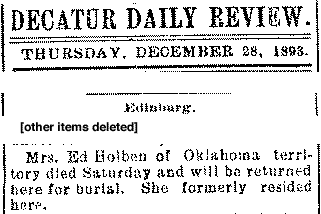
This leads me to the document which made me look at this information again: A small item in the Decatur Daily Review, published December 28, 1893.


Decatur is in Macon County, northeast of Christian County (and Edinburg). The Decatur paper routinely published personal items from neighboring communities as far away as Vandalia.

The problem is immediately obvious: this news bit says that Barbara died on December 23, 1893 not September 23, 1893. This was more than three months after the land run on the Cherokee Outlet, not less than 30 days.

It seems pretty unlikely that the Decatur newspaper published a three month old news item. So, what's the real story?

Here is my hypothesis: Barbara and her two young daughters did indeed travel to Oklahoma to try for some land in September of 1893. They staked a claim and camped on the site, just as the story says. Barbara did indeed fall seriously ill, but (and here is where my version diverges from the original), she didn't pass away immediately. Instead, the Holbens left their claimed land and traveled to Carrie (Holben) Alexander's home in Edmond. They stayed there for three months, and when Barbara finally died in December, her remains were returned to her former home.

I think this probably can be verified in part by finding a story in the local Edinburg or Taylorville newspaper that would have more detail. I'm not sure if such papers exist or are available. Also, the cemetery where Barbara and her husband Edward are buried - Buckhart Cemetery in Grove City - may have some information as to where and when she died. That is the first source of information I'll pursue.

If anyone reading this has any other suggestions, I'm all ears.

Links

Map of Oklahoma showing Indian Nations and later counties. The Cherokee Outlet is the light green area at the top of the map. Edmond is further south in Oklahoma County, near Oklahoma City.

Photos of wagons gathering for the September 16, 1893 land rush.

History of Oklahoma land openings

Decatur Daily Review, December 28, 1893 (NOTE: This is only accessible if you have a subscription at ancestry.com)

Labels: , , ,


Read the rest of this post.

Tuesday, February 07, 2006

Joel Braxton Mabry beat Lewis & Clark to Puget Sound?

As genealogists, we've all gone through county histories hoping to find a biography of one of our more respectable ancestors. Many such books, usually with a title along the lines of "Portrait and Biographical Record of Marion County", were published in the late 1800s and early 1900s. They include a history of the county, its towns and townships, and brief biographies of the more prominent locals. Of course these aren't meant to be rigorous historical essays - they are vanity bios, meant to sell books.

While the subjects are are always described in glowing terms, the recent information is usually fairly accurate. The biographee shouldn't have had any problem supplying his birth date, name of his wife, children, and parents, and location of his business or farm. The information gets less reliable, however, the further you go back in time. It's not surprising that information about great grandpa's service in the Revolutionary War, or a description of the ancestral home village in Germany might not be accurate. Often the stories have enough of a grain of truth to be helpful in piecing together an accurate family history. Sometimes, though, the description of ancestral feats just makes me do a (figurative) double take. The biography of William C. Mabry (born 1871), is just such a history.

According to “History of Glendale and Vicinity” by John Calvin Shere (published 1922), Dr. William C. Mabry was born on October 29, 1871 in Montgomery County, Illinois, the son of William Dudley Mabry (born about 1844) and Irene Dutton (born about 1851). The Mabrys moved from Illinois to McGregor, Iowa in about 1878, where William grew up. His father was a government appointee, eventually moving to Washington D.C. to head a bureau of the U.S. Treasury Department.

William Mabry was a graduate of Western Reserve Medical College in Cleveland, and served as an Army Medic for many years. He first served in the Hospital Corps during the Spanish-American War, and later served in China and the Philippines in the Army Medical service, becoming an expert in tropical diseases. After a number of years working for the Sonora Railroad Company in Mexico, he moved north to Tropico (now part of Glendale), near Los Angeles. He married his wife, Bessie Mayne, in 1904 and they had three children: Janet Elizabeth, Bettie, and William Braxton.

While that's an amazing life story, it is well within the realm of reality. What is a little harder to swallow is the description of his ancestry. According to the biography:
Robert Mabry was a Major in the Revolutionary War serving with the Virginian troops. He was a pioneer in Southern Illinois, where he became a large landowner and a man of big business. Joseph Braxton Mabry, grandfather of Dr. Mabry, was a soldier in the Mexican War. As a young man he, with an older brother, made the trip to Puget Sound, two years before the Lewis and Clark expedition crossed the continent. Mabry’s Landing, a town on the Ohio River, was named after the Mabrys. They were owners and operators of a line of boats on the Ohio and Mississippi Rivers. They were large slave owners, but gave all their liberty before Illinois was admitted as a state.
There are a number of inaccuracies here.

What do we know about William C. Mabry's ancestry?

As it says in the history, William C. Mabry was the son of William Dudley and Irene (Dutton) Mabry. William Dudley and Irene were married on December 1, 1870 in Effingham County, Illinois. The family can be found living in Tama County, Iowa in the 1880 Census.

William Dudley Mabry was born in about 1844, the son of Joel Braxton Mabry and Jane Gamble Copeland. Joel and Jane were married on March 22, 1838 in Johnson County, Illinois. At about that time, Joel purchased land in Pulaski County, where the Mabry family was living when the 1850 Census was taken (at that time, Joel's borther, and our ancestor, Robert Smith Mabry, Jr. was also living with the family). Joel died in 1854 in New Orleans of yellow fever.

Joel Braxton Mabry was born on March 27, 1805 in Pittsylvania County, Virginia, the son of Robert Smith Mabry and Rebecca Adams. Robert Smith Mabry married Rebecca Adams on December 6, 1799 in Pittsylvania County, Illinois. They headed west in about 1812, first settling on the Tennessee-Kentucky border, then pushing on to Marion County, Illinois in about 1827.

That sequence of ancestors - Robert -> Joel Braxton -> William Dudley -> William C. - is at least essntially correct.

Robert Mabry was a Major in the Revolutionary War serving with the Virginian troops.

The statement that Robert Mabry, great grandfather of William C. Mabry, served in the Revolutionary War can be refuted by a single fact: our Robert S. Mabry was born in 1777, one year after the Declaration of Independence was issued. While it can be fun to imagine a toddling warrior fighting the redcoats, the reality is a bit more boring. There was a different Robert Mabry (son of Nathaniel and Susannah Mabry) living in the same part of Virginia who did indeed serve as a Lieutenant in the Revolutionary War. Just to confuse things, this other Robert also had a wife named Rebecca.

Unfortunately the military service for Robert (son of Nathaniel) was submitted to the Daughters of the American Revolution as our Robert (son of Braxton) in the early 1900s, http://www.blogger.com/img/gl.link.gifso old copies of the DAR lineage books carrying this piece of misinformation are still floating around. That was probably William C. Mabry's source of information.

[Robert Mabry] was a pioneer in Southern Illinois, where he became a large landowner and a man of big business.

Robert Smith Mabry and family were indeed pioneers in Southern Illinois, settling in Marion County in 1827. Robert owned at least 120 acres, which may or may not have made home a "large landowner and man of big business".

Joseph Braxton Mabry . . . was a soldier in the Mexican War. As a young man he, with an older brother, made the trip to Puget Sound, two years before the Lewis and Clark expedition crossed the continent.

The first inaccuracy is in the name of William's grandfather: he was Joel and not Joseph. That may have been a natural mistake, however. Robert Smith Mabry, Jr.'s son Joel appears to have gone by "Joe" and this is essentially back-translated as "Joseph" on some records. The same may be true for Joel Braxton.

Was Joel a soldier in the Mexican War? I haven't been able to find any evidence of that. The Illinois Mexican War Veterans Database lists several "Mayberrys" and a "Maybry", but none named Joel. Pulaski County, Illinois does border on Kentucky, so maybe Joel enlisted in that state.

Could he have traveled to Puget Sound before Lewis and Clark? This was the statement that drew my attention to this biography in the first place. I would say that is completely impossible. The first clear inaccuracy is that he supposedly traveled "with an older brother". While Joel did have two older sisters, Martha (Mabry) Allen and Nancy (Mabry) Bass, he was the oldest son of Robert Smith and Rebecca (Adams) Mabry. That might be a trivial issue - he could have traveled with a cousin or a younger brother, for example. A little background information about Lewis and Clark shows that this feat would have been impossible.

Meriwether Lewis and William Clark were chosen to head an expedition exploring the new western territory of the Louisiana Purchase by President Thomas Jefferson in 1803. They reached the Pacific Ocean at mouth of the Columbia River on November 7, 1805. (The Library of Congress has an excellent exhibition on the exploration of America, both before and after Lewis and Clark.)

The problem with the story of Joel's is clear: He was less than a year old when Lewis and Clark arrived in Oregon. I am really curious as to the source of this story. Did a Mabry really make a journey to what would become Washington state in the early 19th century? Was this a tall tale that became a family legend? We may never know.

Mabry’s Landing, a town on the Ohio River, was named after the Mabrys. They were owners and operators of a line of boats on the Ohio and Mississippi Rivers.

I have no idea whether this is true or not. Pulaski County is at the southern tip of Illinois, with the Ohio River forming the boundary with Kentucky. A short distance to the west, the Mississippi River forms the boundary with Missouri. (The meeting of the rivers at Cairo was made famous by Mark Twain). It's possible that there is (or was) a local feature called "Mabry's Landing".

They were large slave owners, but gave all their liberty before Illinois was admitted as a state.

It's not clear who the "they" is in this statement, other than the Mabry family. I could not find a record of Robert Smith Mabry owning slaves in either Virginia, Kentucky/Tennessee or Illinois. On top of that, Illinois became a state in 1818, about 10 years before the Mabrys arrived. The safe bet is that this statement refers to the slaves owned by the Mabrys in Virginia - including Robert's father Braxton Mabry.

Most of the description of the life of William C. Mabry's grandfather and great grandfather was either partially or wholly incorrect. It's a bit of a lesson in the pitfalls of using such biographies in genealogical research.

Labels: ,


Read the rest of this post.

Monday, February 06, 2006

Civil War Soldiers of Fayette County, Illinois: Mabry, Bayles, and Shaffer (and Weiser too)

The Illinois State Archives (a wonderful genealogy resource) has put the Illinois Civil War Muster and Descriptive Rolls online. These not only give the unit that the soldier served in, but also gives a physical description at the time of enlistment.

Unfortunately, I can't link to the entries themselves. Anyone wanthing to look at the records will have to do their own search. Instead, I've summarized the information below. I'll note any information that is incorrect or requires explanation.

Residents of Fayette County, Illinois

The earliest enlistor of our relatives was Dudley Henry Mabry, brother of Robert Smith Mabry, Jr. He enlisted as a first lieutenant in the 35th Illinois Infantry, shortly after the outbreak of the Civil War in 1861. He resigned 1 year into his 3 year tour. Several of his sons subsequently enlisted.

Dudley H. Mabry
(brother of Robert)
Rank: 1 LT - Company H - Unit: 35 IL US INF
Residence: FAYETTE CO, IL
Personal Characteristics
Age: 45 - Height 5' 9" - Hair: LIGHT
Eyes: BLUE - Complexion: FAIR
Marital Status: MARRIED
Occupation: FARMER
Nativity: LOGAN CO, KY
Service Record
Joined When: JUL 3, 1861 - Joined Where: VANDALIA, IL
Joined By Whom: JAS F. HAN - Period: 3 YRS
Muster In: AUG 29, 1861 - Muster In Where: ST LOUIS, MO
Remarks: RESIGNED JUL 16, 1862

Our ancestors Robert S. Mabry, Jr. and Thomas M. Bayles
both joined the Illinois 7th Cavalry in March of 1865, for the period of one year. The ranks of the 7th Cavalry had been severely depleted over the winter of 1864-1865, when many of the soldiers succumbed to disease. In joining the 7th Illinois Cav., they joined young William Mabry, who enlisted at the age of 15 in 1863 and served as the company bugler, and George W. Mabry and Joel N. Mabry, who joined in spring of 1864. At the end of the war, all of them were mustered out of the army in November of 1865 in Nashville.

William D. Mabry
(Son of Robert's brother Joel B. Mabry)
Rank: PVT Company: F Unit: 7 IL US CAV
Residence: SEFTON TOWNSHIP, FAYETTE CO, IL
Age: 15 - Height 5' 1" - Hair DARK
Eyes BLUE - Complexion DARK
Marital Status: N/A
Occupation: FARMER
Nativity: IL
Service Record
Joined When: DEC 15, 1863 - Joined Where: OLNEY, IL
Joined By Whom: CPT O'KEAN - Period: 3 YRS
Muster In: DEC 15, 1863 - Muster In Where: OLNEY, IL
Muster Out: NOV 4, 1865 - Muster Out Where: NASHVILLE, TN
Muster Out By Whom: CPT CHICKERING
Remarks: VETERAN MUSTERED OUT AS BUGLER

George W. Mabry
(Robert's youngest brother)
Rank: PVT - Company: F - Unit: 7 IL US CAV
Residence: LOUDEN CITY, FAYETTE CO, IL
Personal Characteristics
Age: 25 - Height: 5' 9" - Hair: LIGHT
Eyes: BLUE - Complexion: LIGHT
Marital Status: N/A
Occupation: FARMER
Nativity: IL
Service Record
Joined When: FEB 24, 1864 - Joined Where: VANDALIA, IL
Joined By Whom: CPT BISHOP
Muster In: May 24, 1864 - Muster In Where: CAMP BUTLER
Muster Out: NOV 4, 1865 - Muster Out Where: NASHVILLE, TN
Muster Out By Whom: CPT CHICKERING
(note that George W. Mabry may have served for 3 months in 1861 as a Seargent in Company H of the 8th Illinois Infantry. A John R. Mabry, possibly Dudley's son, served as a 2nd Lieutenant in that unit for the same period)

Joel N. Mabry
(son of Robert's brother Dudley)
Rank: PVT - Company: F - Unit: 7 IL US CAV
Residence: VANDALIA, FAYETTE CO, IL
Personal Characteristics
Age: 21 - Height: 5' 8" - Hair: LIGHT
Eyes: GRAY - Complexion: LIGHT
Marital Status: N/A [note: unmarried]
Occupation: FARMER
Nativity: IL
Service Record
Joined When: APR 13, 1864 - Joined Where: VANDALIA, IL
Joined By Whom: CPT BISHOP - Period: 3 YRS
Muster In: MAY 9, 1864 - Muster In Where: CAMP BUTLER, IL
Muster Out: NOV 4, 1865 - Muster Out Where: NASHVILLE, TN
Muster Out By Whom: CPT CHICKERING

** Thomas M. Bayles **
(great grandfather of Neil Mabry and Robert S. Mabry's future father in law)
Rank PVT Company G Unit 7 IL US CAV
Residence SEFTON TOWNSHIP, FAYETTE CO, IL
Personal Characteristics
Age 39 - Height 5' 7" - Hair LIGHT
Eyes GRAY - Complexion LIGHT
Marital Status N/A [note: married to his second wife Mary Ann "Mollie" Turney]
Occupation FARMER
Nativity IL [note: actually born in Virginia]
Service Record
Joined When MAR 2, 1865 - Joined Where OLNEY, IL
Joined By Whom CPT SCOTT Period 1 YR
Muster In MAR 2, 186: NOV 4, 1865 Muster Out Where: NASHVILLE, TN
Muster Out By Whom: CPT CHICKERING

** Robert S. Mabry **
(grandfather of Neil Mabry)
Rank: PVT Company F Unit: 7 IL US CAV
Residence: SEFTON TOWNSHIP, FAYETTE CO, IL
Personal Characteristics
Age 34[note: actually age 39] - Height 5' 11" - Hair: DARK
Eyes: GRAY - Complexion: DARK
Marital Status N/A [note: widower]
Occupation: FARMER
Nativity: KY
Service Record
Joined When: MAR 8, 1865 - Joined Where - OLNEY, IL
Joined By Whom: CPT SCOTT - Period: 1 YR
Muster In: MAR 8, 1865 - Muster In Where: OLNEY, IL
Muster Out: NOV 8, 1865 - Muster Out Where: NASHVILLE, TN
Muster Out By Whom: CPT CHICKERING

William W. Mabry
(Son of Robert's brother Dudley H. Mabry)
Rand: PVT - Company: F - Unit: 7 IL US CAV
Residence: SEFTON TOWNSHIP, FAYETTE CO, IL
Personal Characteristics
Age: 20 - Height: 5' 6" - Hair: LIGHT
Eyes: GRAY - Complexion: LIGHT
Marital Status: N/A [single]
Occupation: FARMER
Nativity: IL
Service Record
Joined When: MAR 8, 1865 - Joined Where: OLENY, IL
Joined By Whom: CPT SCOTT - Period: 1 YR
Muster In: MAR 8, 1865 - Muster In Where: OLNEY, IL
Muster Out: NOV 4, 1865 - Muster Out Where: NASHVILLE, TN
Muster Out By Whom: CPT CHICKERING

Several other Mabry and Bayles cousins enlisted in other Illinois military units:

James C. Mabry
(son of Robert's brother Joel B. Mabry)
Rank: PVT - Company: E - Unit: 32 IL US INF
Residence: VANDALIA, FAYETTE CO, IL
Personal Characteristics
Age: 24 - Height 5' 8-1/2" - Hair: DARK
Eyes: BLUE - Complexion: DARK
Marital Status: N/A
Occupation: TEACHER
Nativity: MASSAC CO, IL
Service Record
Joined When: Mar 24, 1864 - Joined Where: Vandalia, IL
Joined By Whom: CPT JENKINS - Period: 3 YRS
Muster In: MAR 24, 1864 - Muster In Where: CAMP BUTLER, IL
Muster Out: JUL 1, 1865 - Muster Out Where: ST LOUIS, MO
Muster Out By Whom: CPT HAMILTON

Simon C. Shaffer
(this is likely the youngest brother of Neil's great grandmother, Louisa (Shaffer) Bayles)
Rank PVT - Company: H - Unit: 97 IL US INF
Residence: VANDALIA, FAYETTE CO, IL
Personal Characteristics
Age: 24 - Height 5' 7" - Hair: DARK
Eyes: Blue - Complexion: DARK
Marital Status: SINGLE
Occupation: FARMER
Nativity: OH
Joined When: AUG 15, 1862 - Joined Where: VANDALIA, IL
Joined By Whom: J M ERWIN - Period: 3 YRS
Muster In: SEP 8, 1862 - Muster In Where: CAMP BUTLER, IL
Remarks: TRANS DEC 1, 1862 TO NON COM STAFF AS PRIN MUSICIAN
[transfer record lists his last name as Schaffer]
Rank: PMUS - Company: HQ - Unit: 97 IL US INF
Remarks: DIED MAR 17, 1863 ON HOSPITAL BOAT ON MISSISSIPPI RIVER
[at this time many of the soldiers were sickened by small pox]

Simon was the only Mabry-Bayles relative who did not make it home from the war. The Shaffer family moved to Fayette County in the 1850s, but appear to have returned to Ohio in the early 1860s, perhaps after Simon's death.

John Weiser, who didn't live in Fayette County, but has an interesting story

John Weiser, brother of Neil's grandmother, Barbara (Weiser) Holben, had a farm near Beardstown in Cass County. He enlisted as a private in Company A of the 27th IL US Infantry in 1861, and served for 3 years. His story takes on a sort of soap opera quality, because he was supposedly declared dead during the war and his "widow", Ann "Dorothea" (Musch) Weiser, remarried. This was probably quite a shock when John returned to his farm. He subsequently took his three children and moved with his widowed mother (Mary (Grumber) Weiser) to Christian County, where his brother Philip and sister Barbara were living with their families.

More to Come: A post about Robert Smith Mabry's life in the 1860s is in the works. Stay tuned.

Labels: , , , , ,


Read the rest of this post.

Thursday, January 05, 2006

Robert Smith Mabry, Jr.: Growing up in Marion County, Illinois (1825-1850)

As I posted previously, Robert Smith Mabry, Sr. and his family moved from Pittsylvania County, Virginia to the Logan County, Kentucky/Robertson County, Tennessee area in about 1812. Robert Smith Mabry, Jr., youngest son of Robert and his wife, Rebecca Adams, was born in Logan County, Kentucky on December 27, 1825. In about 1827, when young Robert was only two, the Mabry family moved west again, settling in Marion County, Illinois. That is where Robert grew to adulthood and started his own family.

Robert Jr.'s mother, Rebecca, died in January 1828, shortly after giving birth to daughter Susan. Robert Smith Mabry, Sr. was left to take care of his youngest children alone (although he probably had considerable assistance from the older children). He married a second time, to Penelope Hinds, in 1839, when Robert Jr. was 14. Robert's younger brother George was born in about 1840.

As I noted before, Robert "Mayberry" was the schoolteacher in the one room schoolhouse in Racoon Township when it was erected in 1832. Young Robert Jr. most certainly had a basic education, at least enough to learn reading and writing. Most of his time was likely filled by working on his father's farm in Racoon Township.
1875 Plat Map of Marion County. Robert Smith Mabry Sr. had land in Township 1 N, Range 2 E, Section 16. This is east of Centralia, in Raccoon Township. A map of this area shows that it is still primarily farmland today. (Data from the Illinois land Sale Database)
Life was not limited to hard work, however. "Brinkerhoff's History of Marion County Illinois" (pp.105-107) goes into great detail about the passtimes of young men, particularly wrestling, shooting and horse racing. If Brinkerhoff is to be believed, all the contestants had a healthy spirit of fair play and the best prize was simply to be named champion:
The favorite pastime among the boys and young men were running, jumping, wrestling and shooting, which last sport was often curtailed by a scarcity of ammunition, a supply of which must at all times be kept on hand as a protenction for the fmaily form Indian stragglers, and for the stock from the "varmints" [. . .]
Wrestling was of thee kinds and no rules goverened either except a general fairness. The favorite was "side holts," in which, after it had been agreed as to who should have the "under hold," the champions stood side by side with one's right arm and the other's left around the waist of the opponent. [. . .]

In the fall of the year shooting matches were often indulged in open to all, in which the best shot took one hind quarter of a beef, the second best shot took the other, while the third and fourth best took the forequarters, respectively, while the fifth best shot received the "fifth quarter", as the hid and tallow were alled. Cattle being so cheap, the prize was not of so much value as the reputaiton of being the best shot.
In those pioneer times the men and boys would help their neighbors to build new cabins and barns.
A day of toil and a day of jollity was oftne ended with a dance or a party for the young people, either in the new house or the home of some neighbor, where true fronteir hospitality was dispensed with a lavish, if uncouth, hand. [. . .] Corn bread, bear meat, venison, pork, beef, one or all, the succulent succotash, i.e., green corn and strong beans cooked togeether, Irish and sweet potatoes, pumpkin and squash as a "sass," or in pies, with milk or tea from the root of the sassafras, wild honey or maple molasses furnished a meal that fitted the needs of the hardy backwoodsman, and one to which he did ample justice.
Robert Smith Mabry, Sr. died in about 1842, when Robert Jr. was in his late teens, and it is unclear what happened to the family farm. When the 1850 Census was taken, 24 year old Robert was living with his brother Joel in Pulaski County (at the southern tip of the state). He probably worked on his brother's farm.
1850 Census, Pulaski County, Illinois, p. 320b, listing Joel Mabry and family.
Map of Pulaski County. Joel Mabry owned land in Township 14S, Range 2E, section 25 (near Grand Chain).
Shortly after the census was taken, Robert moved to Fayette County, just north of his old home in Marion County, joining his older brother Dudley.

More to come . . .

*Brinkerhoff's History was published in 1909 by B. F. Bowen & Company, Indianapolis, Indiana. This is a very romantic view of life on the frontier.

Labels: ,


Read the rest of this post.

Friday, November 11, 2005

World War I Draft Registration

In 1917 and 1918, all males born between 1872 and 1900 were required to register for the draft. The draft registration cards are a great source of genealogical information, with registrant's home address, occupation and physical description.

Neil Mabry, born in 1902, was not required to register. Neil's dad, Isaac Paris "Pete" Mabry, did have to register.

This is the information he gave:

Name: Isaac Paris Mabry
Address: 912 East 2nd, Pana, Christian County, Illinois
Birth: May 28, 1879 (age 39), native born
Occupation: Club Attendant, LOO Moose No. 1455, North Locust St., Pana, Christian Co., IL
Nearest Relative: Gertie Susanna Mabry, wife, same address.
Description: Tall, Medium Build, Gray Eyes, Brown Hair

One of Pete's brothers also had to register:

Name: Thomas Green Mabry
Address: 626 E. Broadway, Centralia, Marion County, Illinois
Birth: October 14, 1875 (age 42), native born
Occupation: R.R. Switchman, ICRR, Centralia
Nearest relative: Ella Mabry, wife, same address
Description: Medium height, Stout build, light brown eyes, dark brown hair

None of Neil's other uncles had to register, either because they were born before 1872, or because they passed away before 1917. Neither Pete nor Thomas were served in the Great war.

Labels: , ,


Read the rest of this post.

Thursday, November 03, 2005

Mabrys of Vandalia in print

Today was the official launch of Google Print.
Working with the University of Michigan, Harvard University, Stanford University, The New York Public Library, and Oxford University, Google has scanned and made searchable at least ten thousand books, with many more to follow.
As a test, I did a search for Mabry Vandalia.

The only hit was a good one: A page showing the Mabry Court Motel in Vandalia, from the book Vandalia, Illinois by Brenda Baptist Protz.

The whole book looks like an interesting overview of the history of Vandalia, with lots of photos. The bottom line is that I would have been unlikely to run across it without Google Print.

Labels: ,


Read the rest of this post.

Thursday, September 08, 2005

Mini bio: Robert Neil Mabry

A brief Biography of R. Neil Mabry, to whom this blog is dedicated. This is intentionally very sketchy - I hope to fill in the details in future posts.

Neil was born on May 24, 1902 in St. Elmo in Fayette County, Illinois, to Isaac Paris "Pete" Mabry and Gertie Holben. When he was a young boy, the Mabry family moved to Pana in nearby Christian County. This is where he grew to adulthood.

In 1921 he joined the Army Air Corps as an "aero mechanic". (more posts on this at a later date).

After his discharge from the Army, in 1923, he bought a blacksmith shop west of Decatur in the area called Wyckles or Hank's Corner. By the time of his marriage in 1925, he was manager of the Silver Moon Garage in Decatur (this may actually be the shop in Wyckles).

On November 26, 1925, Neil married Esther Kraus in Columbia, Illinois. They returned to Decatur, where they lived until 1929, when they moved to St. Louis, Missouri.

In St. Louis, Neil helped organize the new airline Transcontinental Air Transport (TAT), which eventually became TWA. He and Esther also ran a small grocery store next to their house, where they lived with their two daughters, Nadine and Jacqueline.

In 1941 Neil went to work for the Civil Aeronautic Adminsitration (now the FAA), inspecting privately owned aircraft, first in Santa Monica, then in Oakland, California. This was short-lived, however. After the Japanese bombed Pearl Harbor in December of that year, Neil was drafted into the Air Force and stationed at Wright Field in Dayton, Ohio. There he supervised a number of men in outfitting bombers to fly overseas. After the war ended in 1946, he was discharged with the rank of Major, and returned to California with his family to his job at the Oakland Airport.

Neil retired in 1966, and continued to live in San Leandro, near Oakland, until his death in 1983. His ashes are interred at Chapel of the Chimes in Hayward, California.

Posts about R. Neil Mabry
Neil Mabry: Chief Mechanic at Lambert Field for TAT and TWA

Labels: , , ,


Read the rest of this post.

Tuesday, September 06, 2005

Braxton Mabry IV: Illinois and Missouri

Braxton Mabry and family did not settle in one place for long. The Mabrys and their three grown children left Tennessee for the west in about 1826, when Braxton was 76 . Their first stop was Chariton County, Missouri.

Chariton County, Missouri (1826-1829?)

According to Braxton Mabry's declaration in his Revolutionary War pension file, the first place the family settled after leaving Tennessee was Chariton County, in northern Missouri. They were apparently part of an early boom in the settlement of the area:
In 1820 the tide of migration was directed towards Chariton county and immigrants from the tobacco regions of Kentucky and Virginia came pouring in and other settlements rapidly followed. Farms were opened, mills and manufacturing establishments erected and the settlement of the county commenced in reality. Finding the soil and climate both well adapted to the grown of tobacco, it soon became the staple product and in fact still holds an important position in agriculture. (1896 history of Chariton County)
We know that the Mabrys stay in Chariton County was no more than a few years. By 1829 they had traved southeast, to Macoupin County, Illinois (northeast of St. Louis, Missouri).

Macoupin County, Illinois (1829-<1833)

In Macoupin County Braxton and Nancy, their sons Maximilian and James and daughter Sally (Mabry) Clevenger were founding members of the Concord Primitive Baptist Church in what is now Palmyra.
Pleasant View (formerly Concord) Church was organized June 13, 1829. Eight charter members came together, viz., Braxton Mabry, Christian Mabry, James Mabry, Maximilian Mabry, Nancy Mabry, Sally Mabry, Reuben Clevenger, and Sally Clevenger. Elders William Rodgers, Aaron Smith, and Thomas Lee formed the presbytery. The church was organized before the present town of Palmyra came into being; the town was surveyed and laid out in 1835 under the name of Newburg; the name was changed to Palmyra in 1855. (Primitive Baptist Churches of Macoupin County, Illinois)
The Mabrys were listed in the 1830 Census of the Otter Creek District of Macoupin County.

• "Joell Maybury" was listed as head of a household with one man and one woman age 18-20, and three boys, two under age 5 and one age 5-10.

• "Maxemillian Maybury" was listed as head of a household with one man and one woman age 30-40, one boy under age 5, two boys and three girls age 5-10, and two girls age 10-15.

• "James Maybery" was listed as head of a household with one man age 80-90, one woman age 60-70, one man and one woman age 30-40, and one girl age 5-10. The older couple are probably Braxton and Nancy.

• "Reuben Clevenger" was listed as head of a household with one man and one woman age 40-50, one boy and one girl under 5, one boy and one girl age 5-10, two boys age 10-15, one boy age 15-20, and one woman age 20-30.

Several of Braxton's grandchildren (or their husbands) also have households listed in the 1830 census of Macoupin county.

Reuben Clevenger purchased land in North Otter Township in 1833 and 1836 (T12N R7W Section 31). However, by that time Braxton had once again moved west, to Greene County in the southwestern corner of Missouri. (from the Illinois Public Land Sale Database)

1875 Map of Macoupin County (Reuben Clevenger's land was near the intersection of North and South Otter and North and South Palmyra districts).

Greene County, Missouri (1833-1836)

In his 1838 pension application, Braxton stated that he and his family had moved to Greene County in 1833, in the southwestern Missouri Ozarks. We find two of Braxton's sons on the 1833 Greene County Tax list:

• "James Mabery" had 4 cattle, 1 "poll".
• "Joel Maberry" had 1 cattle, 1 "poll".

Neither were taxed for slaves, horses or mules. Braxton, son Maximillian, and son-in-law Reuben Clevenger were not on this list.

Once again, they had settled in an "uncivilized" area with few resources:
Old timers have told me that one of the first tasks of the pioneer, after he had found a suitable place for a home, and had thrown together some sort of a rude shelter to protect his family from storm and cold, was to fashion a mortar wherein to reduce the grains of corn to particles small enough to serve as food. And this, we may be sure, was no small under-taking to a man whose only implement for the purpose was, in most cases his faithful axe. (Past and Present of Greene County, Missouri)
Taney County, Missouri (1836->1840)

In 1837 Greene County was split, with Taney County formed from the southern part that borders on Arkansas. Braxton Mabry applied for a pension for his service during the Revolutionary War in 1838 while living in Taney County. .

The 1840 census for Taney County places Braxton in Swan Township, living with his son James (see original census pages 115 and 115A and alternative transcription).

At that time, Maximillian Mabry was living in neighboring Barry County. Reuben Clevenger was living in Marion Township of Taney County.

It is not known when Braxton died. By 1840 he was almost 90 years old. When he submitted his pension application, he was infirm and blind. It is likely that he died in Taney County shortly after 1840. However, no record of his death has been found.

Note that I have seen no indication that Braxton even knew that his son from his first marriage, Robert S. Mabry, settled in Illinois in 1827. There was no apparent contact between Robert and Braxton's younger children.

1838 Map of Missouri (click to zoom)
Taney County Township Map (1990) (Taney County's current claim to fame is as the home of Branson, Missouri)

James, Maximillian and Joel

Maximillian Mabry eventually left Barry county (he may have lived breifly in Lawrence County and Jasper County), and joined his brothers in Taney county. Max, along with his brother James and Reuben Clevenger were all listed there in the 1850 census (Jasper and Swan townships).

James Mabry appears to have remained in Taney County until at least 1850. It is not known when he died. (Could he be the "Jimmie Maberry" who was a preacher in Marion County, Arkansas, just south of Taney County?)

Maximillian Mabry and family moved to Benton County, Arkansas during the Civil War. This was followed by several other moves, eventually ending up in Franklin County, Kansas. (read letters written during the 1860s for more of his family history)

Joel Mabry died in about 1846 (his estate was "issued to Maximillian Mabry" on 30 Mar 1846), probably in Taney County.

Reuben and Sally (Mabry) Clevenger continued living in Jasper Township in Taney County, until they both died, between 1860 and 1870. Their descendants lived in Taney County into the 20th century (and may still live there today).

Labels: , , ,


Read the rest of this post.

Saturday, July 16, 2005

The Bayles Family: Migration Along the National Road

In about 1859, Thomas and Louisa (Shaffer) Bayles uprooted themselves from their home in Muskingum County, Ohio and migrated 400 miles with their children to a new home in Fayette County, Illinois. (Map). It is probably no coincidence that the major overland route from the east to the western states, the so-called "National Road", passed through Muskingum County, crossed Indiana, finally terminating in Fayette County.

Construction of the National Road begain in Maryland in 1815. Surveying, grading, clearing, laying stone and building bridges took decades. The route finally reached Vandalia, Illinois in 1838. In the succeeding years many settlers traveled the road from Ohio into Illinois. Many of them, like Thomas and Louisa Bayles, settled in Fayette County. Others continued west.

Thomas and Louisa settled, at least briefly, in Cumberland (now Otego) Township, near Hickory Creek. The Bayles family eventually moved closer to the town of St. Elmo, in Avena Township, where Thomas was a farmer.

By the 1860s, the expanding network of railroads was already making the National Road obsolete. Taverns, inns and other businesses that had prospered with the traffic eventually disappeared. The 20th century brought a revival of the road - today highway 40 closely follows the original route.

Louisa died in 1869, and is buried in Howard's Point. Thomas remarried (twice) and moved to Missouri in 1890. He died in Kansas City in 1901.

Links
THE NATIONAL ROAD
The National Road (National Park Service Exhibit)
History Magazine: The National Road
History of the National Road (with emphasis on Fayette County, Illinois).
The National Road: a Photo Essay (covers Maryland through Ohio)

FAYETTE COUNTY, ILLINOIS
Map of the National Road into Fayette County, Illinois
1875 Township Map of Fayette County (large image)
History of Vandalia, Illinois

MUSKINGUM COUNTY, OHIO
Photos of the National Road near Zanesville
The National Road in Eastern Ohio (note: lots of graphics)
Zanesville, Ohio History

Labels: , , ,


Read the rest of this post.

Sunday, October 24, 2004

Robert Smith Mabry, Sr.: Last residence in Marion County, Illinois (1827-1842/5)

In about 1827, Robert Smith and Rebeccah (Adams) Mabry and their children headed west again, eventually settling in Marion County, Illinois . Their son (and our ancestor) Robert Smith Mabry, Jr. would have only been about 2 years old when the family moved.

The Mabry family had lived about 15 years along the Kentucky-Tennessee border, before moving. It is likely that the oldest Mabry daughters, Martha and Nancy, married while the family still lived in Kentucky.

Once again, they were not alone in their move. Rebekkah's brother, John Adams, also moved from Logan County, Kentucky to Marion County, Illinois. Many other families from Kentucky and Tennessee also made the move, settling in the "Tennessee Prairie" area of Raccoon Township, in the southern part of the county.
"Tennessee prairie, so called because settled by Tennesseeans, is in the northwest and extends to Little Prairie, to which it is connected by a narrow strip. Like all settlements of Illinois, the first settlers chose the timber land; first, because they found it more convenient to build and for fuel; second, because they were used to timber and loved its protection from the summer sun and blast of winter; third, the flies with which the prairie was infested, especially the green-heads, rendered it almost impossible for horses to work during the heat of the day."
Rebeccah did not live long in Illinois. She died on January 26, 1828, three days after giving birth to the youngest Mabry child, Susan. (note: it is possible that Rebeccah died shortly before the Mabry family moved to Illinois)

Robert Mabry not only worked his farm and raised his children, he also contributed to the community:
"The first school-house was erected in section 18 [of Raccoon Township], in 1832. It had a chimney and fire place and no floor, but mother earth. The first teacher in this primitive school-house was Robert Mayberry."
Robert purchased several tracts of land from the Federal Goverment in Section 16 of Raccoon township in 1837-1839, totalling 120 acres.

Also in 1839, Robert married for a second time, to Penelope Hinds, almost 30 years his junior. They had one son, George W. Mabry.

Robert died in 1842 or 1845, in his late 60s, and was buried in Burge Cemetery in Raccoon Township.

All quotes are from "Brinkerhoff’'s History of Marion County Illinois" published in 1909 by B. F. Bowen & Company, Indianapolis, Indiana. (pages 104-111 and 171-173). This is a very romantic view of life on the frontier.

Note that the the family name is often spelled "Mayberry" in early documents.

Links
Illinois Public Domain Land Tract Sales Database
Illinois Land Plat Maps (1804-1891): For Marion County select "Southern Illinois"

Mini biography: Robert Smith Mabry, Sr.

Previous posts:
Robert S. Mabry: Live in Kentucky & Tennessee (1812-1827)
Robert S. Mabry: Life in Pittsylvania County, Virginia (1777-1812)
.

Labels: , ,


Read the rest of this post.

Saturday, August 14, 2004

Pete & Gertie Mabry: Life in Pana, Illinois

Isaac Paris "Pete" Mabry and Gertie Holben were married in 1899. The newlyweds initially lived in Vandalia, Illinois in Fayette County, where Pete was a "farmer" (according to the 1900 census). It seems that Pete was not interested in following in his father's footsteps as a farmer, despite the fact he inherited 160 acres of land from his father in 1884 (held in trust until he was "of age"). The Mabrys moved from Vandalia to Pana, Illinois in Christian county, some time between 1900 and 1910. We don't know much about their early years in Pana, but we have a few hints.

• There was a "Pete Mabry" who played for the Pana minor league baseball team in 1905. In 1904 Mabry played for the Vandalia team.

• A Pete Mabry opened a bar in Pana in 1905. According to the August 30, 1905 Decatur Review, "Pete Mabry, the ball player sold out his half interest [in one saloon], and now Mabry and Adrian Williams, also a ball player, have opened a saloon at the old Condon stand which will be recognized as the sporting resort." Was our Pete Mabry a baseball player?

• My recollection (please correct me if I'm wrong) was that there was a story about Pete Mabry meeting the brother of Jesse James. There's no way to know for sure if there was such a meeting, but Jesse's brother Frank James was the starter at the race track at the 1906 Pana Fair, so it was certainly possible (from the Illinois Sesquicentennial Edition of Christian County History Vol. 2 p. 210).

• 1910 Census: "I. P. Mabry", Gertie and children Bonnie, Neil and Hilda were living in Pana City . Pete's occupation was a bartender in a saloon.

1914 City Directory: Pete and Gertie living at 912 E 2nd St. (no occupation listed)

• 1918 : WW I draft card for Isaac P. Mabry. He was still living at 912 E 2nd St., working as a Club Attendant, Employer: L O O Moose No. 1455 on North Locust St. [the first Moose lodge in Pana was founded in 1913]

Moose Home
The Moose Home (photo from MelvaKaye Rowe)

• 1920 Census: Pete, Gertie and children Bonnie, Neil, Hilda, Harry and Jennie [Lorretta] living at 309 E. Washington St. Pete is listed as working at the Moose Home.

• August 4, 1921: Decatur Review reports "Pete Mabry has broken ground for the erection of a new home on East Washington street, just east of the present Moose home."

The Mabrys moved to a farm five miles south of Herrick (between Pana and Vandalia), then a year later moved to Decatur. They ended up back in Vandalia in 1925, where they ran a tourist camp.

Pictures of Pana in "days gone by": 1st site - 2nd site.

Labels: , ,


Read the rest of this post.